



The recap
1. Winch or hoist?
A winch pulls a load and, depending on its design, holds it. A hoist is designed to lift and lower a load under control. That typically means the brake, wire rope size and drum diameter are larger than on a comparably rated winch. For example, ASME B30.16 (base-mounted hoists) calls for a minimum 5:1 ratio of wire rope breaking strength to load, where ASME B30.7 (base-mounted winches) requires 3.5:1. Never use a winch to hoist.
2. Line pull
Required line pull = W × (GR + CF): the load’s weight times the grade resistance plus the coefficient of friction. A 4,000 lbs load on wheels (CF 0.03) climbing a 10% grade (GR 0.100) needs 4,000 × 0.130 = 520 lbs of pull. Lift it straight up and GR = 1.0, so the line pull equals the full weight. When one line isn’t enough, reeve it through sheaves for more parts of line.
3. Line speed
At a constant drum RPM, every layer of line adds diameter, so each turn pays out more line: more speed and less pull from the same motor. Columbia ratings are on the first layer of line; check the pull and speed on the layer of line your drum will actually be working on.
4. Horsepower
Theoretical horsepower = line pull (lbs) × line speed (fpm) ÷ 33,000. Lifting 2,000 lbs at 33 fpm takes 2.0 HP. That’s theoretical: the real motor must be larger to cover gear, bearing and rigging losses. At the same horsepower, more pull means less speed and more speed means less pull.
The application guidelines behind it
Each idea has its own one-page guide, with the tables and worked examples.
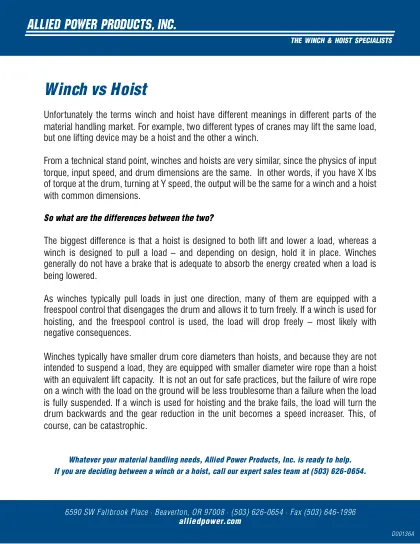 Winches Versus HoistsDoc 136ARead the guide →↓ PDF
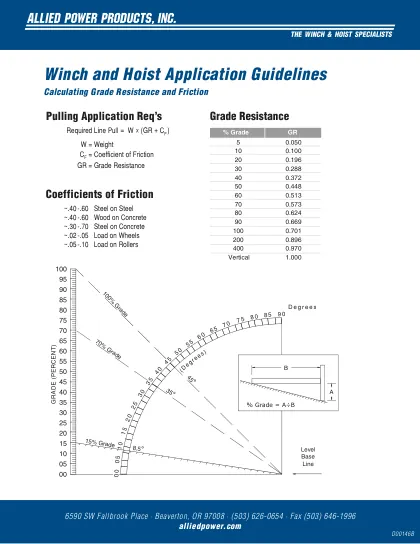 Line PullDoc 146BRead the guide →↓ PDF
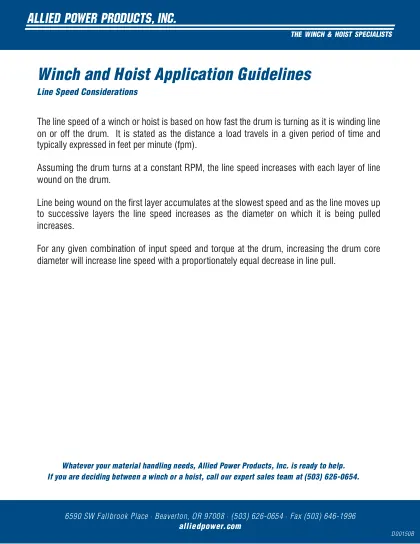 Line SpeedDoc 150BRead the guide →↓ PDF
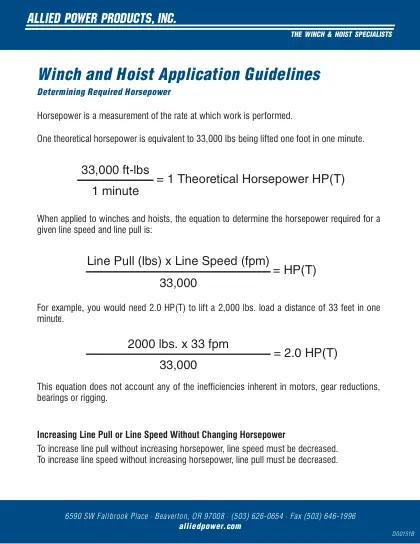 HorsepowerDoc 151BRead the guide →↓ PDF
Need more information?
Mounting templates, specification guides, worksheets and the rest of the application guidelines (fleet angle, duty cycle, wire rope selection, travel distance and more) are on the Resources page.
Have questions? Contact us
Let the selector do the math: line pull, speed, horsepower, rope and duty cycle for real Columbia models.
Call (503) 626-0654 or email info@alliedpower.com.