



Industries · Resources & Marine
Barge Winches & Barge Positioning Systems
Columbia barge positioning systems haul, return and hold barges along a dock so each hold can be spotted under a loading spout or unloader. The winches are AC electric or pneumatic, to 40,000 lbs on a single line; the controls are engineered to the dock: synchronized haul and payout, back tension so the line never goes slack, load monitoring, position feedback and interlocks with the loader. Built to order in Beaverton, Oregon since 1983.
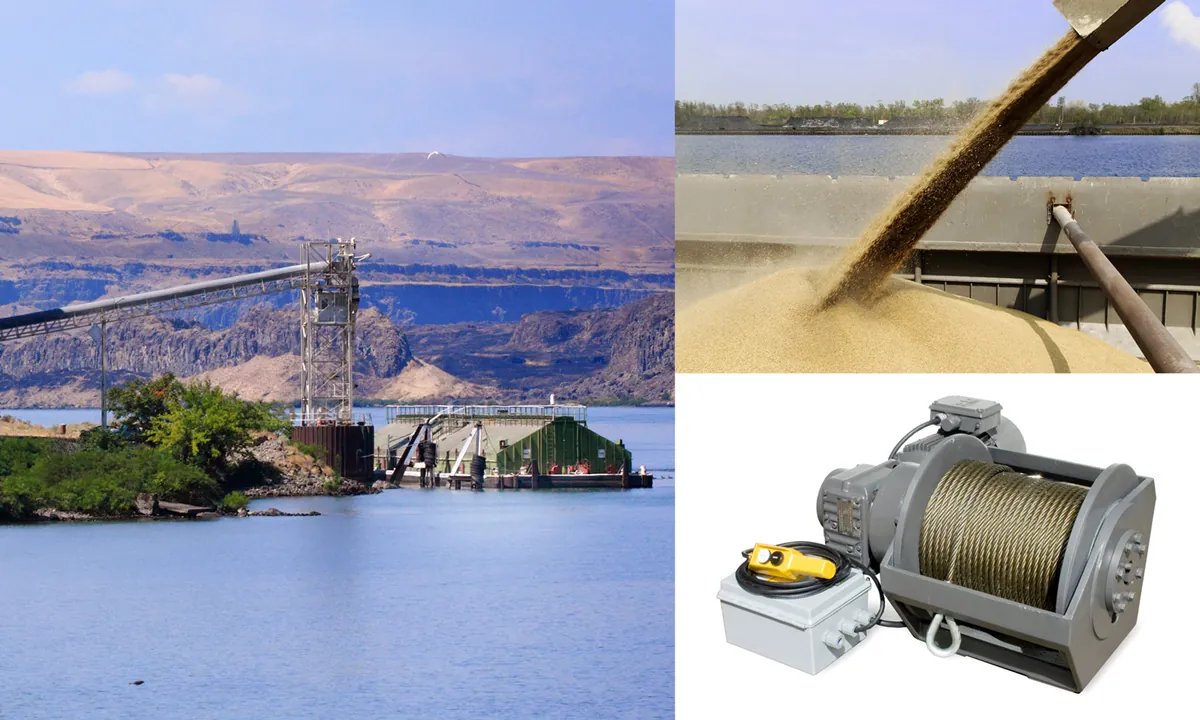
What barge positioning is
Barge positioning, also called barge haul, barge moving, barge pulling or barge spotting, moves a moored barge along the dock face so the loader, spout or unloader works one hold after another. The barge stays afloat and tied off; base-mounted winches on the dock supply the pull, through lead sheaves or fairleads at the dock edge to bollards or chocks on the barge.
Done by winch, the move is repeatable and controlled from the dock, without holding a tug on station. The same equipment family covers related marine jobs: fleeting winches that bring barges alongside a working barge, mooring-line winches, and the spout hoists that set chute height as a barge loads.
The weather, the current and the barge’s weight leave little margin for error, so every system is sized to the site.
One winch or two
- Two-winch system (haul + return)A winch at each end of the berth, each line to one end of the barge. One winds in while the other pays out under control, so the barge moves either way and is held between two brakes when stopped. The usual layout for spotting under a loader.
- Single winchPulls one way only; the return comes from the current or a tow. Suits a berth where the current always sets the same way and the move is always in one direction.
- Multi-winch systemsMooring and fleeting winches on a working barge, run from one control panel, to hold the barge over a work area and bring other barges alongside.
A two-winch barge positioning system
Plan view at a loading dock. The haul winch winds in while the return winch pays out; reverse them to move the barge back.
Winches
Base-mounted on the dock, set back from the edge with room for a correct fleet angle to the first sheave. Each brake holds the barge when the winch stops.
Lead sheaves and fairleads
Turn the line from the winch to the barge at the dock edge. Lead sheaves keep the wire rope on the drum at a correct fleet angle; an AutoAdvance line spooler helps when the drum is wide or the sheave is close.
Bollards and chocks
The connection on the barge. Line length per move and the reach to each bollard set the rope length on each drum.
Controls
One station runs both winches: synchronized haul and payout with back tension, variable speed, load and position readout, and interlocks with the loader. Pneumatic units use local or remote valve control. How the controls work →
Controls, engineered to order
Control systems for barge positioning
The winches supply the pull; the controls decide whether a barge stops exactly under the spout or drifts off it. We engineer the control system with the winches: two winches run as one, a held back tension on the paying-out line, the pull and position read back to the operator, and the loader tied in. Tell us how the dock runs and we build the panel around it.
Synchronized haul and payout
One operator command runs both winches: the haul winch winds in while the return winch pays out at the same speed. Variable-frequency drives with encoder feedback match speed and position between the two, the same way we synchronize multi-hoist systems. The barge moves either way and stops where it is put, held between two brakes.
Back tension, so the line never goes slack
The paying-out winch doesn't just free-spool. Its drive holds a set back tension on the return line, so the barge can't drift or surge when the current or the load shifts, and the line spools back on its drum in even wraps. Tension limits set on the panel keep either line from being pulled past its setting.
Load monitoring and limits
A load cell, load pin or line-tension sensor on each line reads the pull, with a display at the operator station or a signal to your system. Drive current limiting or a current-sensing relay caps the pull, so the winch stalls instead of overloading the rope, the bollard or the dock.
Position and travel
Encoders on the drums show where the barge is and how far it has moved. Multi-turn absolute encoders keep position through a power loss; a sheave sensor reads true line speed on multi-layer drums. Rotary or whisker limit switches keep the minimum wraps on each drum and stop travel at the ends of the berth.
Speed control
Drives give a slow creep for spotting a hold and full speed for the move between holds, with adjustable ramps that take the shock out of starts and stops on the rope, the bollards and the barge.
Operator stations
A joystick console with winch selection and a line-tension display, a touchscreen operator panel, a NEMA 4X pendant or a wireless remote, so the operator can stand where the hold and the spout are in view. Every station carries an emergency stop.
Interlocks with the loader
The panel exchanges signals with the elevator, conveyor or spout controls, so loading and barge moves happen in the right order. A spout hoist can be run from the same station as the barge winches.
Built for the dock
Enclosures matched to the site: NEMA 4X, NEMA 3R with fans or air conditioning in direct sun, panel heaters for cold, UL 508A panels where required, and hazardous-location rated controls for classified grain areas.
Three levels of control
Most docks fall into one of these. The panel can start simple and grow: the same winches take a synchronized or monitored package later.
| Level | How it works | Typical dock |
|---|---|---|
| Basic | Each winch on its own reversing starter and pendant, or one station with an A / B / Both selector | Short berths, light barges, an operator watching both lines |
| Synchronized | A drive on each winch with encoder feedback; the return winch pays out at the haul speed while holding back tension | Spotting holds under a loader; most grain and bulk docks |
| Monitored and integrated | Synchronized control plus line-tension readout and limits, travel limits, a touchscreen or joystick console, and I/O to the loading controls | Long berths, strings of barges, automated loading, recorded loads |
Control systems we've built: Barge positioning winch system (joystick speed control, winch selection, line-tension display with adjustable limiting) · Tensioning winch system · Dual winch positioning system · Excavator barge winch system
Sizing a barge winch
Line pull is the force to move and hold the barge, not the weight of the cargo. It has to cover:
- Current on the submerged hull, which grows with draft: a loaded barge is harder to move than an empty one.
- Wind on the exposed hull and cargo, which is highest on an empty, high-riding barge.
- Starting the mass moving: the loaded barge plus the water it carries with it.
- Losses in the lead sheaves, and the tension held on the opposing line in a two-winch system.
Then line speed (how far each move is and how quickly it has to happen), rope length on each drum, and duty cycle: how many moves per barge and per shift. Speed and pull trade off at a given horsepower.
Wire rope is sized to the line pull: ASME B30.7 calls for a 3.5:1 design factor and a 15:1 minimum D:d; the EN 14492-1 / general rule is 2:1 and 10:1. Keep the fleet angle between 1/2° and 1-1/2°: the minimum distance in feet from the drum to a fixed sheave is about the drum width in inches.
Sizing guides
One-page guides to the numbers we ask for, or let the Winch & Hoist Selector check every Columbia model against your pull, speed and rope length.
- Line pull
- Line speed
- Horsepower
- Travel distance
- Wire rope
- Fleet angle
- Duty cycle
- Multiple parts of line
- Operating environment
Built examples. Figures from published Solution Spotlight jobs, first layer.
Grain barge positioning
- Layout
- Two winches in tandem
- Line pull
- 9,000 lbs
- Line speed
- 16 FPM
- Rope
- 368 ft of 5/8"
- Power
- 460 V 3Ø 60 Hz
- Motor
- IP66, strip heater
Mooring line hoist
- Line pull
- 2,100 lbs
- Line speed
- 24.1 FPM
- Rope
- 200 ft of 5/16"
- Power
- 230 V 3Ø 60 Hz
- Control
- Removable pendant, e-stop
- Spooling
- Cable tension plate
Columbia winches for barge positioning
Maximum rated line pull is single line, first layer, for the largest standard model in each series. Each series page has full ratings, rope capacity and downloads. Most barge systems are built to order around one of these.
| Series | Max rated pull | Motor / power | For barge work |
|---|---|---|---|
| AC electric | |||
| W2K Series | 18,000 lbs | 1 – 3 HP · 1Ø or 3Ø | Lightweight; three drum sizes; installs at any angle |
| WN Series | 20,000 lbs | 3 – 10 HP · 1Ø or 3Ø | Oil bath for continuous duty; 384 ft of 1/2" rope |
| WT Series | 20,000 lbs | 2 – 10 HP · 1Ø or 3Ø | Manual freespool standard, for paying out line to the barge |
| WR Series | 40,000 lbs | 3 – 10 HP · 230/460 V 3Ø | Highest-capacity AC winch; oil bath for continuous duty |
| Pneumatic | |||
| WN Series | 20,000 lbs | 6.25 HP vane · 80 psi, 215 SCFM | Where electric power is unsafe or unavailable |
| WR Series | 40,000 lbs | 6.25 or 12.5 HP vane · 70–80 psi | Largest pneumatic winch; local or remote pendant |
Need more pull or speed than a standard model? Rig multiple parts of line or ask about a custom winch. Hydraulic winches and self-contained systems suit barges and sites without shore power; capstans handle soft mooring line.
Spout and chute hoists
As a barge loads it settles in the water, so the loading spout or chute has to come down with it to keep the drop short and the dust and spill down. A base-mounted hoist on the loader raises and lowers the spout, and it can be run from the same operator station as the barge winches.
Mooring and fleeting winches
Dock-side mooring winches and mooring-line hoists take in and hold lines to a barge or vessel at a berth, and fleeting winches on a working barge bring other barges alongside and hold them over a work area. Ours are powered, base-mounted drum winches and hoists with the same control options: one built mooring-line hoist pulls 2,100 lbs at 24.1 FPM on 200 ft of 5/16" rope, with a removable pendant.
We don't build class-approved shipboard mooring machinery or manual ratchet winches for lashing a tow.
Docks, weather and grain dust
- Sealed drivetrain: the WN, WR and WT have gears and bearings sealed in an oil bath; the W2K and the pneumatic winches have totally enclosed geartrains.
- Motors and controls: TEFC motors on the AC range; NEMA 4X controls available. A built grain-dock system uses IP66 motors with strip heaters.
- Marine finish: marine coatings and corrosion-resistant components for dock and deck service; stainless wire rope where specified.
- Brakes: load-holding brakes set automatically when power or air is removed and hold the barge (spring-applied on the WN, WR and pneumatic series).
- Slack line: a cable tension plate or cable tensioner keeps the rope from bird-nesting on the drum when the barge surges and the line goes slack.
Grain and dusty areas
Grain loading and unloading areas can be classified for combustible dust. Pneumatic winches run where electric power is unsafe or unavailable, and explosion-proof electric units are available for classified areas. Tell us the class, division and group, or zone, of the area where each winch and its controls will sit.
Never for people. Columbia winches and hoists are not to be used to lift or move people, or to lift anything over people.
What we need to quote a barge winch system
Send what you know; an engineer will follow up on the rest. A dock sketch with dimensions helps more than anything.
- Barge size: length, beam, and draft empty and loaded
- Loaded displacement or cargo weight, and the cargo (grain, aggregate, coal…)
- Number of barges moved at once, and the berth length
- Travel per move and total travel along the dock
- Speed you need (feet per minute) and moves per barge or per shift
- Current speed and direction at the berth; river level or tide range
- Wind exposure
- One-winch or two-winch layout, if decided
- Winch locations, lead sheave or fairlead points, and bollard positions on the barge
- Power on the dock: voltage and phase, or air pressure and flow
- Area classification (combustible dust or other), and spray, washdown and freezing exposure
- Control location: at the loader, pendant, remote, or tied into the loading controls
- Control functions: run both winches together, back tension, line-tension readout or limits, position readout, travel limits, interlocks with the loader or spout
- Wire rope standard, if you have one (ASME B30.7 or EN 14492-1)
- Photos of the dock and the existing equipment
Barge and marine positioning at work: Solution Spotlight
Barge, mooring and positioning jobs we’ve engineered and built.
 Solution Spotlight · WinchBarge Positioning Winch SystemRead the story →
 Solution Spotlight · HoistBarge Positioning HoistRead the story →
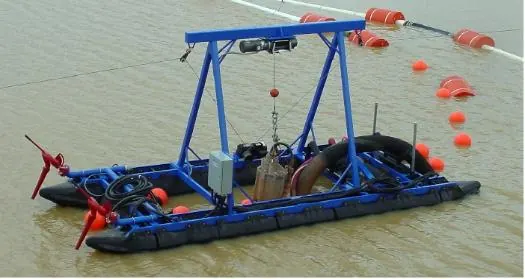
 Solution Spotlight · WinchCustom Hydraulic Electric Winch System Excavator BargeRead the story →
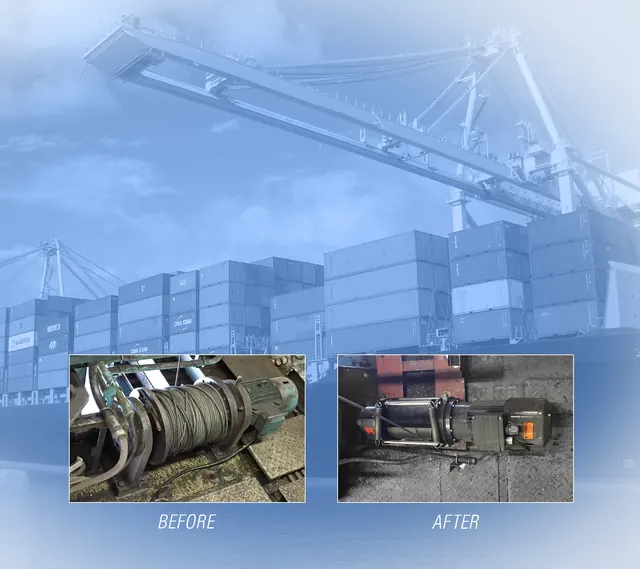 Solution Spotlight · WinchLarge Vessel Mooring WinchRead the story →
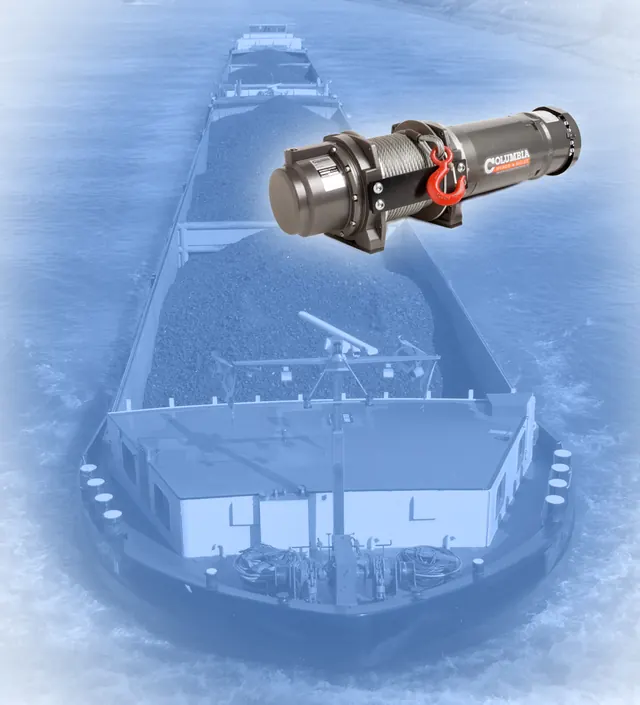 Solution Spotlight · HoistSpout Hoist Loads BargesRead the story →
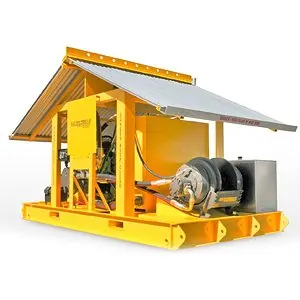 Solution Spotlight · WinchSelf Contained Winch System for Construction Barge SpudsRead the story →
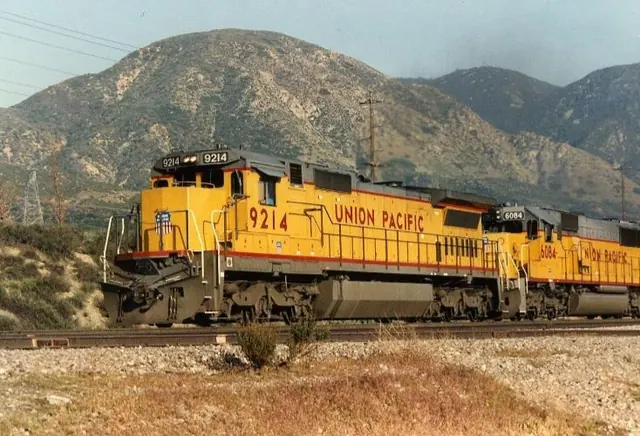 Solution Spotlight · WinchRailcar Positioning Winch SystemRead the story →
Barge winch questions
What is a barge positioning winch?
A barge positioning winch is a base-mounted drum winch, usually on the dock, that moves a moored barge along the dock face with wire rope, so each hold can be spotted under a loading spout or unloader without a tug. Most systems use two winches: one hauls while the other pays out under control, so the barge can be moved either way and held in place. Standard Columbia barge winches are AC electric or pneumatic, to 40,000 lbs on a single line.
Do I need one barge winch or two?
Two winches, a haul line and a return line, give control in both directions: one winds in while the other pays out and keeps the barge from drifting, and both brakes hold it when it is stopped. A single winch pulls one way only, so the return has to come from something else, such as the current or a tow. Tell us how the current sets at your dock and we will recommend a layout.
How much line pull does a barge positioning winch need?
It depends on the barge and the site, not on the cargo weight alone. Line pull has to overcome current and wind on the barge, start the loaded mass moving, and cover friction in the lead sheaves and the pull of the opposing line. Send the barge size and draft (empty and loaded), current, wind exposure and the travel per move and we will size it. One built two-winch grain-loading system uses 9,000 lbs at 16 FPM per winch. See the Line Pull guide for the basics.
Can a Columbia winch run outdoors on a dock?
Yes, specified for it. The WN, WR and WT series have gears and bearings sealed in an oil bath, and the AC range uses TEFC motors with NEMA 4X controls available. For marine sites we add marine coatings and corrosion-resistant components; one built barge positioning system uses IP66 motors with strip heaters. Tell us the exposure (spray, washdown, freezing) when you ask for a quote; the Operating Environment guide lists what we ask.
Electric or pneumatic winches for a grain dock?
Either can work. AC electric is the usual choice where the area is unclassified. Grain-handling areas can be classified for combustible dust; there, pneumatic winches are an option where electric power is unsafe, and explosion-proof electric units are available. Tell us the area classification. See hazardous-location units.
How are barge winches controlled?
From one operator station that runs both winches. AC systems use a drive on each winch so the haul winch winds in while the return winch pays out at the same speed and holds back tension, with joystick or touchscreen control, line-tension readout and limits, encoder position feedback, travel limits and interlocks with the loader. Simpler docks can use reversing starters with an A / B / Both selector and a pendant or wireless remote. Pneumatic winches use local or remote valve control. One barge system we built has joystick speed control, winch selection and a digital display of line tension with adjustable tension limiting.
What is back tension in a barge positioning system?
Back tension is the pull the paying-out winch keeps on its line while the other winch hauls. Instead of free-spooling, the return winch's drive holds a set tension, so the barge can't drift or surge off position and the line spools back on the drum in even wraps. It is set on the control panel along with tension limits for both lines.
Can the control system show line tension and limit the pull?
Yes. A load cell, load pin or line-tension sensor on each line reads the pull, shown at the operator station or sent to your system as a signal. Drive current limiting or a current-sensing relay caps the pull so the winch stalls before it overloads the rope, the bollard or the dock.
Is a barge winch the same as a towboat deck winch?
No. The deck winches on a towboat that lash barges into a tow are a different machine, often manual ratchet winches. A barge positioning winch is a powered, base-mounted drum winch that moves a moored barge along a dock, or holds and fleets barges from a working barge. Columbia builds the powered kind, AC electric or pneumatic, to 40,000 lbs on a single line.
Do you build mooring winches?
Yes, for docks, berths and working barges: powered base-mounted drum winches and mooring-line hoists sized to the line pull, rope and controls of the site. One built mooring-line hoist pulls 2,100 lbs at 24.1 FPM on 200 ft of 5/16" rope with a removable pendant and a cable tension plate. We don't build class-approved shipboard mooring machinery.
Can the loading spout be raised and lowered with the same equipment?
Yes. A base-mounted hoist on the loader can raise and lower the spout or chute as the barge settles, and it can be run from the same operator station as the barge winches. Tell us the spout weight, travel and the area classification.
Tell us about the dock
Send the barge size, current, travel and power you have. An engineer will come back with questions or a price range.