



Products · Systems & packages
Winch & Hoist Controls
Every Columbia winch and hoist can ship with controls matched to the job: a simple pendant, a weatherproof low-voltage station, variable speed, a wireless remote, or a custom panel with position feedback, limits and load monitoring. Controls are wired to the unit and checked before it ships, or we supply the unit without controls for your own panel.
Custom panel Operator console with touchscreen and joysticks7 photos
Which control type fits?
Start with how the unit will be run: who operates it, from where, how precisely the load has to be placed, and what else it has to talk to.
| Control type | How it works | Best for | Good to know |
|---|---|---|---|
| Drum switch / full-voltage pendant | The switch carries motor current directly. Power-in / power-out buttons, one speed. | Small single-phase units, indoor, intermittent duty | Pendant rated NEMA 12 (indoor). Only on models offered in single-phase. |
| Low-voltage pendant (single-speed) | A control box with a reversing starter steps power down for the pendant circuit. | Most standard units, indoor or outdoor, any voltage or phase | Control box and pendant rated NEMA 4X. Our most common package. |
| Variable speed (VFD) | A drive varies motor speed, ramps starts and stops, and limits current. | Precise positioning, soft handling, slow creep or faster payout | Sized for winch or hoist duty, with braking resistor and enclosure to suit the site. |
| Wireless remote | Handheld radio transmitter with a receiver in the control panel. | Operator needs to move to see the load; long reach; multi-unit systems | Pairs with single-speed or variable-speed controls. |
| Custom control package | Engineered panel with encoders, limits, load sensing, interlocks or PLC interface. | Synchronized units, automated cycles, monitored or recorded loads | Quoted to the application. |
| No controls (customer-supplied) | Unit ships with motor and brake wired to a terminal point. | Machine builders and plants with their own panels | We supply the wiring diagram and motor/brake data. |
Single-speed
Drum switches, full-voltage and low-voltage controls
Single-speed controls run the unit at its rated line speed in both directions. The brake sets automatically when the button is released.
Model code FDrum switches & full-voltage pendants
The simplest control: a reversing switch that carries motor current, on a handheld pendant with power-in and power-out buttons. Nothing to mount but the unit itself.
- Pendant rated NEMA 12 for indoor use
- Available only on models offered in single-phase (115 V or 230 V 1Ø)
- Good for light, intermittent duty close to the unit
Model code LLow-voltage controls
A control box with a reversing starter converts input power to a lower control voltage for the pendant, so the operator never handles line voltage. Works on single-phase and three-phase units at any standard voltage.
- Control box and pendant rated NEMA 4X, indoor or outdoor
- Shipped pre-wired to the motor and pendant
- Our most common package on standard units
Model code XNo controls
The unit ships without controls for your own panel or machine controller. We supply the wiring diagram, motor and brake data, and can advise on starter sizing and brake wiring.
- Common for OEM and plant installations
- Hoists need the brake wired to set whenever the motor is off
Reading the model number
HG3700-4A34-L-01
On AC electric units the letter after the voltage and motor speed is the control type: F = full-voltage, L = low-voltage, X = no controls. Pneumatic model numbers don't carry a control code, so tell us which control you need.
Pendant and station options
- Two-button pendants in NEMA 4X, NEMA 6 and other ratings
- Emergency-stop button
- Speed potentiometer (with variable speed)
- Wall-mount NEMA 4 station with keyed switch
- Hazardous-location rated stations
- Extended pendant cords
Long pendant cords can reduce control voltage and unit capacity. Tell us the cord length you need and we'll size the controls for it.
Variable speed
Variable speed controls (VFD)
A variable frequency drive (VFD) lets the operator inch a load into place, ramps every start and stop, and limits motor current. Drives are set up for winch or hoist duty and built into an enclosure matched to the site.
Precise positioning
Slow, controllable creep speeds for placing a load, aligning a fixture or engaging a connection, with full speed for the rest of the travel.
Soft starts and stops
Adjustable acceleration and deceleration ramps reduce shock loads on the rope, rigging and structure, and keep swinging loads under control.
Current and torque limiting
The drive can limit motor current so the unit stalls instead of overloading the rope or the structure it pulls against.
Extended speed range
Drives can run the motor from 0 to 120 Hz. Above rated speed torque falls off, which suits fast payout of light loads. On 460 V 3Ø, high-torque packages up to 60 HP hold 60–100% of rated torque to 120 Hz.
Running continuously at reduced speed
Motors cool themselves with a shaft fan, so long runs at low speed need help. Duty-cycle limits still apply at every speed.
| Continuous speed | What it takes |
|---|---|
| 30–60 Hz | VFD |
| 10–30 Hz | VFD plus a separately powered blower, or an oversized motor |
| 0–10 Hz | VFD, encoder feedback and blower |
Planning the installation
- Braking resistor: built into the VFD enclosure on winches; supplied as a separate NEMA 3R resistor on hoists
- Outdoor panels need shade or cooling: NEMA 3R with fans, or air conditioning in hot sun
- Heaters for cold sites, washdown and dust-tight enclosures
- UL 508A panels where the site requires them
- Speed potentiometer, multi-step buttons or a speed signal from your control system
- Ambient temperature range and altitude set the drive size
Faster lowering is for light loads only. A hoist on a VFD can pay out at about twice rated speed when the load is under roughly 25% of rated capacity. Heavier loads must be lowered at rated speed or slower.
DC units use a regenerative DC drive instead of a VFD, with the same speed control, adjustable ramps and current limiting. They can run continuously at any speed up to rated, within the duty cycle. See DC electric winches & hoists.
Wireless
Wireless controls
A handheld radio remote replaces the pendant cord, so the operator can stand where the load, the rope and the people around it are in view. Remotes work with single-speed and variable-speed controls, and with multi-unit systems.
- Stop button on the transmitter
- Single-speed or multi-step speed buttons
- Works with single units and multi-unit systems
Pneumatic
Pneumatic controls
Air winches and hoists are controlled by valves instead of electrics, which keeps them simple in washdown and many hazardous-location jobs.
- Local control: valve mounted on the motor
- Remote control: pendant-operated valves on an air hose
- Throttling control gives variable speed by hand
Custom & specialized
Custom and specialized control packages
When a pendant isn't enough, we engineer the control package with the winch or hoist: sensors on the drum and sheaves, limits, load monitoring and the logic to tie them together. These are the monitoring and control requirements we see most, and how we meet them.
| What you need | How we address it |
|---|---|
| Show line speed | Low-resolution incremental encoder (motors to 7.5 HP), or a hall-effect sensor at the sheave, which reads true line speed on multi-layer drums |
| Measure and control line speed | High-resolution incremental encoder with a VFD |
| Know where the load is | High-resolution incremental encoder (re-zero after a power loss), multi-turn absolute encoder (keeps position through a power loss), or a sheave hall-effect sensor |
| Stop at the top (upper limit) | Paddle switch, crane-block switch or whisker switch |
| Stop at the bottom / keep wraps on the drum (lower limit) | Whisker switch, rotary limit switch or multi-turn absolute encoder |
| Monitor line tension or load | Load cell, load pin or line-tension sensor, with readout or a signal to your system |
| Limit pull to protect the load or structure | Current-sensing relay, or VFD current limit |
| Smooth starts and stops | High-inertia motor fan on a reversing starter (soft, not instant), or VFD ramps |
| Run in an extreme environment | Panel heaters or air conditioning, Class H motor insulation for wide temperature ranges, hazardous-location rated controls |
| Lock against back-driving | Ratchet and pawl with a limit switch that confirms the pawl is released; VFD current limiting recommended |
| Talk to your plant or machine control | Custom panel with the inputs, outputs, interlocks and signals your PLC needs |
Synchronizing several units
From loosest to tightest:
- Independent controlsEach unit has its own pendant; operators coordinate by eye.
- Reversing starters with A / B / Both selectorRun units singly or together from one station.
- VFDs with incremental encodersPrecise speed and position matching; re-zero after a power loss.
- VFDs with multi-turn absolute encodersPrecise matching that keeps position through a power loss.
Choosing an encoder
| Your goal | Encoder |
|---|---|
| Display movement or speed only | Low-resolution incremental |
| Measure and control speed | High-resolution incremental |
| Load position only | Multi-turn absolute |
| Load position and speed, or synchronizing several units | Multi-turn absolute with sin/cos (an incremental encoder can substitute but needs re-zeroing after a power loss) |
Packages we build
- Synchronized multi-hoist systems for stages, installations and test fixtures
- Aerostat systems: main tether hoist on a VFD, mooring hoists on reversing starters, load pin with inclinometer, radio remote
- Variable-speed explosion-proof hoists with NEMA 7 pendants
- Recovery and test winches with load-cell tension monitoring
- Tensioning systems that hold a set line pull
- Self-contained systems with power, controls and unit on one skid
Controls change what a unit can do, not what it is rated for. Columbia winches and hoists are never used to lift or move people, or to lift anything over people, whatever the control package.
Control systems we've built: Solution Spotlight
Variable speed, synchronized and monitored systems engineered for real jobs.
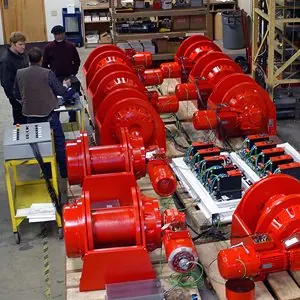 Solution Spotlight · HoistSynchronized Multiple Hoist SystemRead the story →
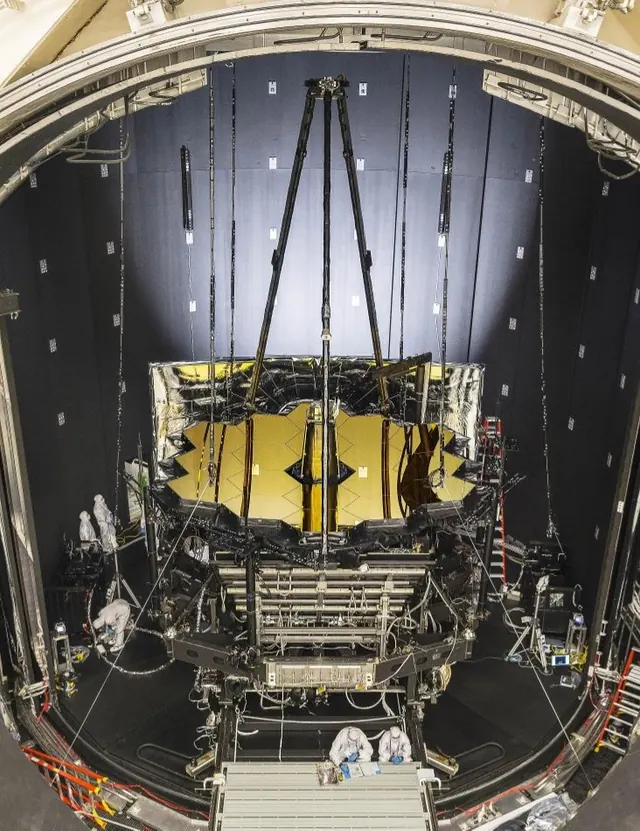 Solution Spotlight · HoistVariable Speed Hoists Suspend James Webb Space TelescopeRead the story →
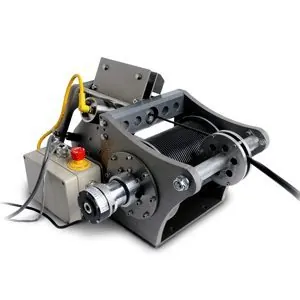 Solution Spotlight · WinchDC Electric Recovery Winch for Mars RoverRead the story →
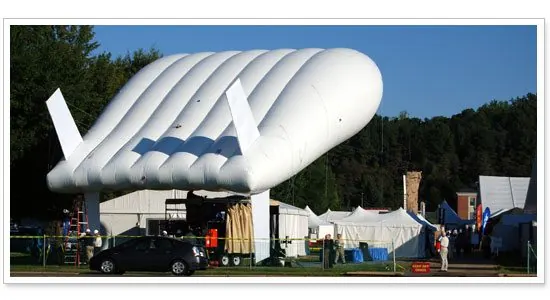 Solution Spotlight · WinchAerostat Winch Launch RecoveryRead the story →
 Solution Spotlight · HoistGranville Street Bridge ChandelierRead the story →
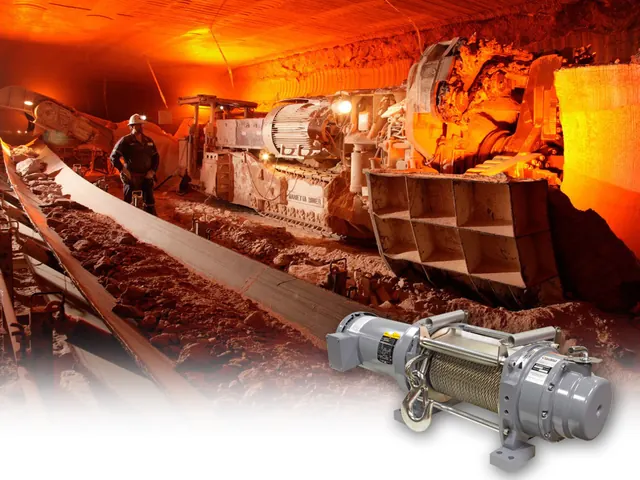 Solution Spotlight · WinchTensioning Winch SystemRead the story →
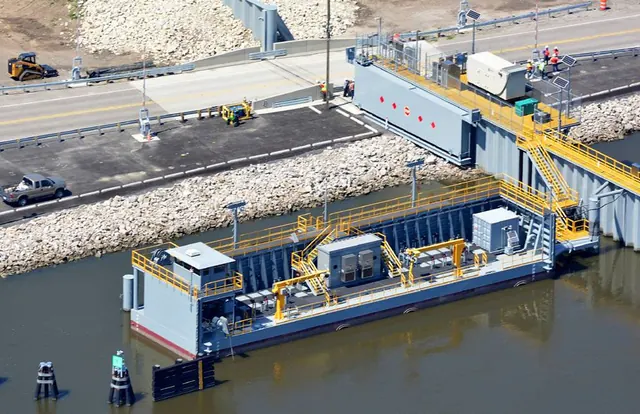 Solution Spotlight · WinchDual Winch Positioning System for Louisiana Flood GateRead the story →
What we need to quote a control package
- Winch or hoist, model if known, and the load
- Input power: voltage, phase and frequency
- Who supplies the controls: us, or your own panel
- Operator station: pendant, wall station, wireless, or panel-mounted
- Speed: single speed, or variable (range, and how long at low speed)
- Functions: ramping, torque limiting, upper and lower limits, load or position readout
- Signals or interlocks to and from other equipment; fused main disconnect
- Enclosure rating; indoor or outdoor; direct sun, rain or snow; washdown; dust
- Ambient temperature range and altitude
- Hazardous location: Class, Division and Group
Controls questions
What's the difference between full-voltage and low-voltage controls?
With full-voltage controls the pendant switches the motor directly, at line voltage. They are offered on single-phase models and the pendant is rated for indoor use. Low-voltage controls put a reversing starter in a control box so the pendant runs at a lower control voltage; the box and pendant are rated NEMA 4X for indoor or outdoor use and work on any standard voltage and phase.
Can I use my own controls?
Yes. Order the unit without controls (model code X) and we supply the wiring diagram and motor and brake data. On hoists, the brake must be wired so it sets whenever the motor is not powered.
Can a VFD make my winch or hoist faster?
Only with light loads. Above rated speed the motor loses torque, so a hoist can pay out at about twice rated speed only when the load is under roughly 25% of rated capacity. For more speed at full load, the unit needs a different motor or gear ratio; the Winch & Hoist Selector shows the options.
Will my unit run on 50 Hz power?
Yes, at 220 V or 400 V. Line speed is about 17% slower than the 60 Hz ratings.
Can the controls connect to our PLC?
Yes. Custom panels can take start, stop, direction and speed commands from your system and return position, speed, load and fault signals. Tell us the signals and interlocks you need.
Are controls available for hazardous locations?
Yes. Explosion-proof pendants, stations and panels are built to the Class, Division and Group of the area. See hazardous-location winches & hoists.
Tell us how it needs to run
Send the unit, the power and how it will be operated. An engineer will come back with questions or a price range.